
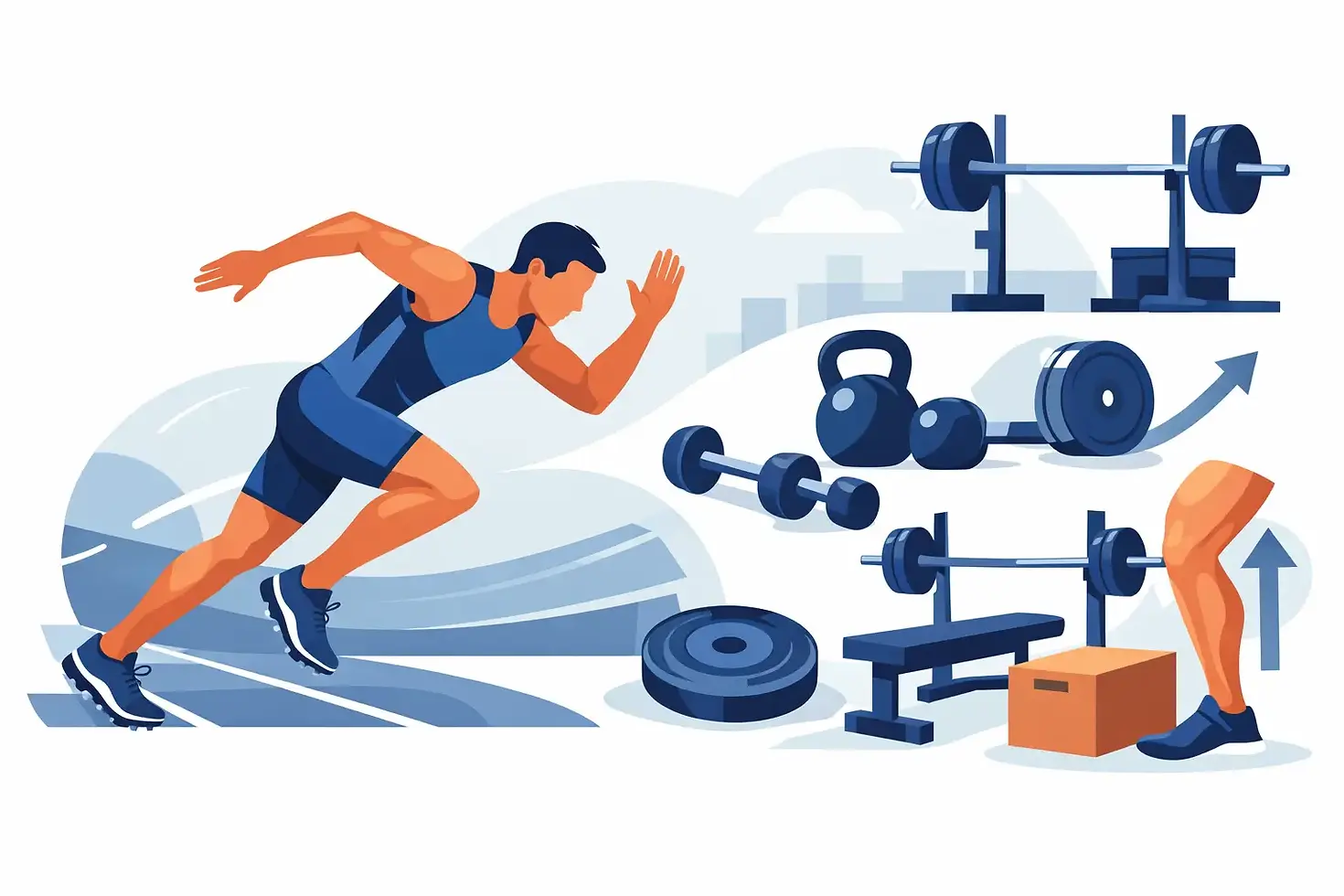
7 Best Strength Lifts for Sprinters

A faster 100 meters is not built by chasing sore legs in the gym. It is built by choosing lifts that actually transfer to acceleration, max velocity, and force production on the track. The best strength lifts for sprinters are not always the flashiest ones, and they are definitely not the ones that leave you too fatigued to hit quality sprint work.
For sprinters, the weight room has one job - support speed. That means the best exercises improve how much force you can apply, how quickly you can apply it, and how well your body holds sprint positions under pressure. A lift can be great for general strength and still be a poor fit for sprint development if it adds fatigue without improving the qualities that matter most.
What makes the best strength lifts for sprinters?
Sprinters need a blend of raw force, stiffness, coordination, and posture. The gym should help build those qualities, not compete with them. That is why exercise selection matters more than collecting random lifts from social media.
A good sprint lift usually does one of three things well. It builds lower-body force in positions that matter for acceleration, it strengthens the posterior chain so the athlete can project and recover efficiently, or it improves trunk and pelvic control so power is not leaking every step. The best programs usually combine all three.
There is also a trade-off to respect. The strongest athlete in the weight room is not automatically the fastest on the track. At a certain point, more loading stops helping if movement quality drops, recovery suffers, or the athlete loses rhythm and sharpness. Sprinters need enough strength to express speed, not strength for its own sake.
1. Back squat
The back squat remains one of the most effective tools for developing general lower-body force. For many sprinters, especially developing athletes, it is a reliable way to build strength through the hips, knees, and trunk while teaching them to produce force into the ground.
Its value is highest when it is coached well and loaded with purpose. A strong squat can help an athlete improve acceleration qualities, particularly in the early phases where projecting force matters. It also gives coaches a clear way to track progress over time.
That said, not every sprinter needs to chase maximal back squat numbers forever. Longer-limbed athletes, those with a history of back irritation, or highly advanced sprinters may respond better when the squat is kept in the program but no longer treated as the main event.
2. Front squat
If the back squat is the broad strength builder, the front squat is often the cleaner option for athletes who need more posture and control. The front rack position encourages a more upright torso, better trunk stiffness, and cleaner mechanics under load.
For sprinters who fold forward in acceleration or struggle to stay organized through the torso, front squats can be a strong choice. They usually require less load than back squats to create a significant training effect, which can reduce wear and tear while still building force.
This is one of those it depends lifts. Some athletes front squat beautifully and get a lot from it. Others are limited by mobility, wrist discomfort, or poor rack position, and the lift becomes more of a fight than a development tool.
3. Romanian deadlift
Few lifts carry over to sprint support work as consistently as the Romanian deadlift. Sprinting is heavily posterior-chain dominant, and the RDL builds strength in the hamstrings, glutes, and spinal erectors in a way that fits that demand.
What makes it especially useful is the emphasis on hip hinge mechanics and eccentric control. Sprinters need hamstrings that can handle high forces, especially late in swing and during ground contact. The RDL does not replicate sprinting, but it helps prepare the tissues and patterns that sprinting depends on.
Done well, the lift teaches athletes to load the hips without losing position. Done poorly, it turns into a lower-back exercise. The standard should be simple - long spine, controlled lowering, tension in the hamstrings, and no chasing range of motion that the athlete cannot own.
4. Trap bar deadlift
The trap bar deadlift is one of the most practical lifts in sprint performance because it gives athletes a strong return without the same technical barrier as a straight-bar deadlift. For many sprinters, it is a smart blend of force production, simplicity, and manageable fatigue.
It can be loaded heavily to build absolute strength or performed more explosively for power emphasis. That flexibility makes it useful across different training phases. Younger athletes and field-sport sprinters often learn it faster than more technical barbell lifts, which means more quality reps and less wasted time.
The caution is that heavy pulling still carries recovery cost. If sprint quality is dropping because the athlete is grinding through trap bar sessions, the dosage is too high. In a sprint program, the lift should support the fast work, not hijack it.
5. Hip thrust
The hip thrust gets mixed opinions in track circles, but when used correctly, it has clear value. It targets hip extension strength directly and can help athletes develop force through the glutes without as much axial loading as squats.
For athletes returning from injury, managing spinal load, or needing extra glute strength, hip thrusts can be an efficient option. Some sprinters also feel a strong transfer to block clearance and early acceleration because of the emphasis on horizontal force expression.
Still, this lift is often overhyped. Hip thrusts should not replace foundational strength work. They are best used as a complement, not the centerpiece of the entire program.
6. Split squat or rear-foot elevated split squat
Single-leg strength matters for sprinters because sprinting is a series of violent single-leg contacts. Split squat variations help build force, stability, and control through each side independently, which can expose asymmetries and improve joint integrity.
These lifts are especially valuable for athletes who collapse at the hip, lose pelvic control, or struggle to hold positions under fatigue. They also tend to be friendlier on the spine than heavy bilateral lifts, while still creating a serious strength stimulus.
The rear-foot elevated version increases range and challenge, but it is not automatically better for everyone. Some sprinters get more from a standard split squat if they can load it harder and keep better alignment. The goal is not to make the lift more complicated. The goal is to make it more useful.
7. Olympic lift derivatives
Power cleans, clean pulls, and high pulls earn their place because they train rapid force production. Sprinters do not just need strength. They need to express it fast. Olympic lift derivatives can help bridge that gap when coaching quality is high.
For many athletes, the derivatives are a better option than full Olympic lifts. A clean pull or high pull often gives the explosive stimulus you want without the technical demands of catching the bar. That means less time learning and more time producing quality power outputs.
This category is highly coach-dependent. In a well-run program, these lifts sharpen power. In a poorly run one, they become noisy, rushed, and disconnected from sprint outcomes. The standard is speed, timing, and intent - not just moving a barbell around aggressively.
How to prioritize lifts in a sprint program
The best sprint programs do not try to fit every good lift into one week. They choose a small number of high-value movements and organize them around the demands of track work. Usually that means pairing the highest neural stress lifts with acceleration or speed days, then keeping lower-priority gym work away from sessions where freshness matters most.
A developing sprinter may do very well with a squat, an RDL, a split squat, and one explosive pull. An advanced athlete may need even less, but with sharper intent and tighter loading. More exercises do not mean more transfer.
At Next Gen Sprints, that coaching lens matters. The weight room should reflect the athlete in front of you - their training age, event profile, injury history, sprint mechanics, and competition calendar. A 15-year-old building general strength should not train like a senior sprinter chasing hundredths.
Common mistakes when choosing strength lifts
The biggest mistake is picking lifts based on gym culture instead of sprint demands. Sprinters do not need bodybuilding fatigue, random circuits, or max-effort lifting every week. They need targeted strength that leaves room for real speed development.
Another mistake is forcing every athlete into the same exercise menu. Some athletes thrive on front squats. Others get better results from trap bar work and split squats. Some tolerate Olympic derivatives well. Others need simpler power options.
Finally, coaches and athletes often ignore timing. Even the right lift becomes the wrong lift if it shows up at the wrong point in the week or the wrong phase of the season. Great programming is not just exercise selection. It is sequence, dosage, and recovery.
The best strength lifts for sprinters are the ones that build force, protect sprint mechanics, and leave the athlete more prepared to run fast - not just more prepared to lift heavy. Choose lifts with intent, coach them to a high standard, and let the stopwatch be the judge.


Comments