
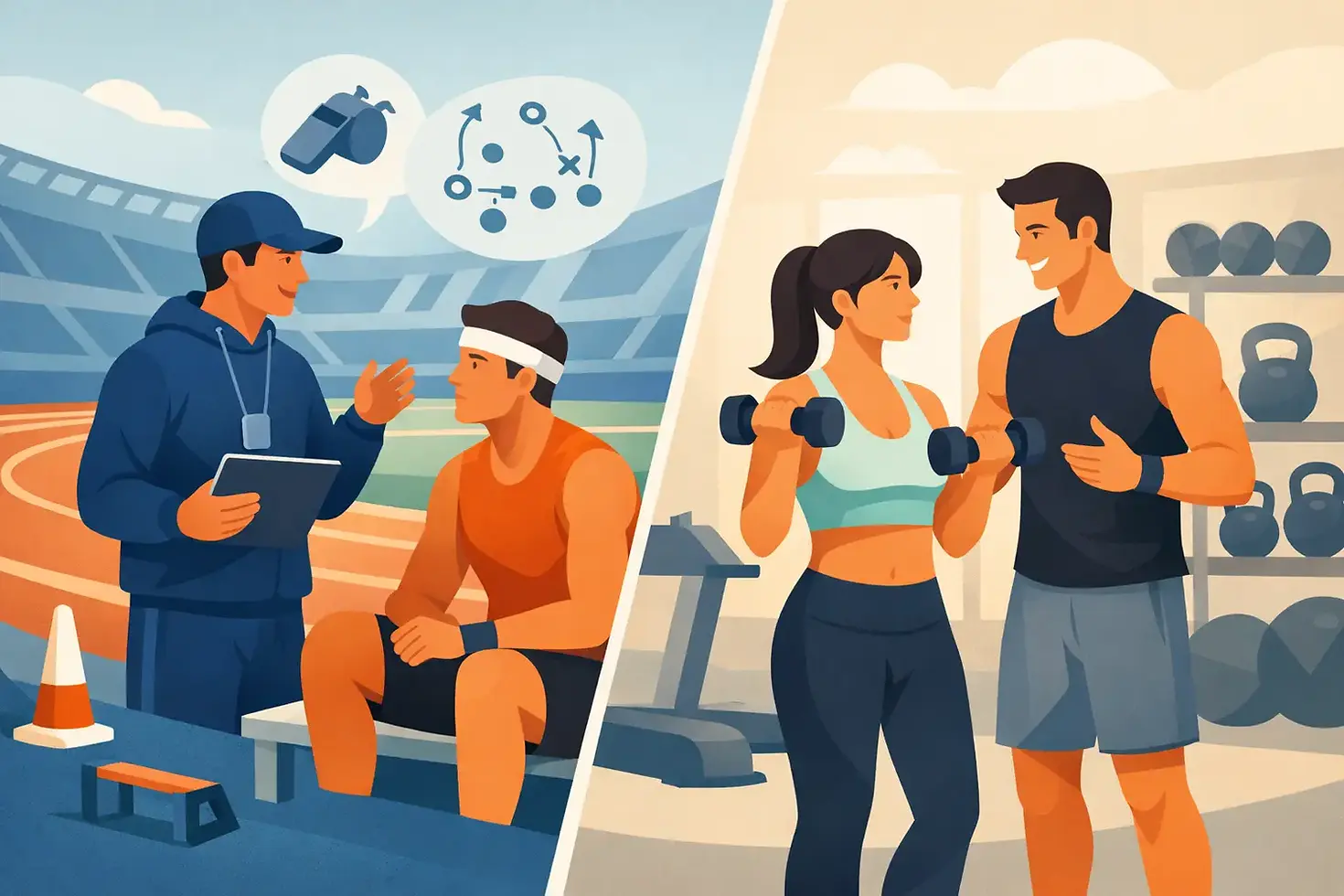
Sports Performance Coach vs Personal Trainer

A faster first step, cleaner sprint mechanics, more force off the ground, and confidence returning after an injury do not come from random hard workouts. They come from training with a purpose. When comparing a sports performance coach vs personal trainer, the right choice depends on what you are training for: better general health, or better performance when the race, game, or tryout matters.
Both professionals can help you become stronger and more consistent. But athletes, parents, and serious fitness enthusiasts should understand the difference before committing time, energy, and money to a program. The coach who gets you tired is not always the coach who prepares you to perform.
Sports Performance Coach vs Personal Trainer: The Core Difference
A personal trainer is typically focused on improving general fitness. Their work may include weight loss, muscle gain, cardiovascular conditioning, movement habits, basic strength, and accountability. For someone beginning a fitness routine or looking to feel healthier and stronger, that support can be highly valuable.
A sports performance coach works from a different starting point: the demands of the athlete's sport. The question is not simply, “How can we make you fitter?” It is, “What does your event or position require, where are you losing performance, and how do we build the qualities that transfer?”
For a sprinter, that may mean acceleration angles, front-side mechanics, stiffness through ground contact, and force production. For a soccer player, it could mean repeat sprint ability, deceleration, change of direction, and resilience through a long season. For a basketball athlete, it may involve jump mechanics, reactive strength, lateral movement, and landing control.
The distinction matters because fitness is broad. Performance is specific.
What a Personal Trainer Does Well
A quality personal trainer can create structure for people who need a clear plan and someone to keep them accountable. They may teach foundational exercises, improve confidence in the gym, build basic strength, and help clients establish sustainable nutrition and lifestyle habits.
For an athlete in the early stages of training, this foundation can be useful. Learning to squat, hinge, push, pull, brace, and move with control is never wasted. A trainer with strong coaching skills can also be a good fit during an off-season when the primary goal is rebuilding general strength or body composition.
The limitation appears when the athlete's needs become more technical or sport-specific. A generic program built around fatigue, calorie burn, or popular exercises may not address why an athlete is slow out of the blocks, struggles to stop safely, loses posture at top speed, or cannot maintain power late in competition.
Hard sessions are not automatically high-performance sessions. If training creates exhaustion but does not improve the qualities that decide your sport, it can leave an athlete working hard without moving forward.
What a Sports Performance Coach Brings to the Process
A sports performance coach looks beyond the workout. They assess the athlete's movement quality, training history, event demands, competition calendar, strengths, gaps, and recovery capacity. Then they organize training around measurable progression.
For athletes, this often includes technical coaching alongside physical development. Sprinting, jumping, cutting, and throwing are skills. They require instruction, repetition, feedback, and the right dose of intensity. You cannot build elite speed by treating it like a cardio workout.
A performance coach also understands that strength work must support the field or track. The goal is not just to lift more weight. The goal is to produce force in useful positions, apply it quickly, stay durable under pressure, and express that ability when it counts.
At Next Gen Sprints, that standard is shaped by Olympian-led methodology: train with intent, measure what matters, and develop the athlete instead of chasing short-term fatigue. This is especially valuable for young athletes who need to build their physical foundation without rushing their development or copying adult programs from social media.
Technical Development Is a Major Separator
The biggest difference is often technical expertise. A personal trainer may be able to lead a strength session. A sports performance coach should be able to identify whether an athlete is overstriding at speed, collapsing through the hips during acceleration, wasting movement during a cut, or landing in a position that raises injury risk.
Small technical corrections can create major gains over time. An athlete who learns to project effectively in the first steps of a sprint, maintain posture as velocity rises, and apply force efficiently will usually see more meaningful progress than one who simply adds more conditioning.
This does not mean every performance session has to look complicated. The best coaching often makes training clearer. Athletes know what they are working on, why it matters, how to execute it, and how progress will be measured.
Which Option Fits Your Goal?
Choose a personal trainer if your main objective is general health, weight management, basic gym confidence, or building a consistent exercise habit. A skilled trainer can be an excellent partner when your goals are not tied to a competitive sport or specific performance outcome.
Choose a sports performance coach if your goal is to run faster, jump higher, become more explosive, improve sport movement, prepare for competition, or return from a setback with a structured plan. This is also the better path when you need coaching that connects training directly to your event, position, or season.
For a young athlete, the decision should be based on more than the label. Ask whether the coach has experience teaching athletes at the right developmental stage. Youth training is not adult training made lighter. It requires sound progressions, clear communication, technical patience, and an understanding of how to develop confidence alongside physical ability.
For a committed fitness enthusiast, it depends on the target. If you want to look and feel stronger, a trainer may be enough. If you want to improve your 100-meter time, prepare for a fitness test, build true athletic movement, or train with the discipline of a competitor, performance coaching offers a more precise framework.
Ask Better Questions Before You Commit
The strongest coaching relationship begins with the right questions. Rather than asking only about price or session length, ask what the coach assesses before building a plan. Find out how they measure progress beyond body weight or how tired you feel after training.
Ask how they adjust training during a competitive season, how they teach movement mechanics, and what they do when an athlete is returning from injury. A serious coach should be able to explain how speed, strength, power, mobility, and recovery fit together without promising instant results.
You should also ask whether the program is individualized. Group training can be powerful, especially when athletes feed off a high-standard environment. But athletes still need appropriate progressions based on age, experience, current capacity, and goals. The same drill, load, or volume is not right for everyone.
Be cautious with anyone who guarantees a scholarship, a specific race time, or rapid transformation. Great coaching creates the conditions for improvement. It cannot replace consistency, recovery, nutrition, competition experience, or the athlete's willingness to learn.
Why Athlete Development Takes More Than a Workout
Performance rarely improves in a straight line. An athlete may make a breakthrough in speed, then need time to build the strength and control to hold that new level safely. Another athlete may be physically capable but need technical refinement, confidence, or smarter recovery to show their ability in competition.
That is why the best performance coaches act as mentors as well as instructors. They teach athletes how to approach training, respond to setbacks, and understand the standards required for long-term progress. The gym, track, and field become places to build discipline, not just fitness.
A personal trainer can be part of an athlete's support system, particularly for general strength or lifestyle habits. But when the mission is athletic performance, coaching should be built around the sport rather than borrowed from general fitness.
The right choice is the one that respects your goal. If you want to move better, compete harder, and develop abilities that show up when the clock starts or the whistle blows, choose guidance that treats you like an athlete and gives your development the patience, precision, and purpose it deserves.


Comments